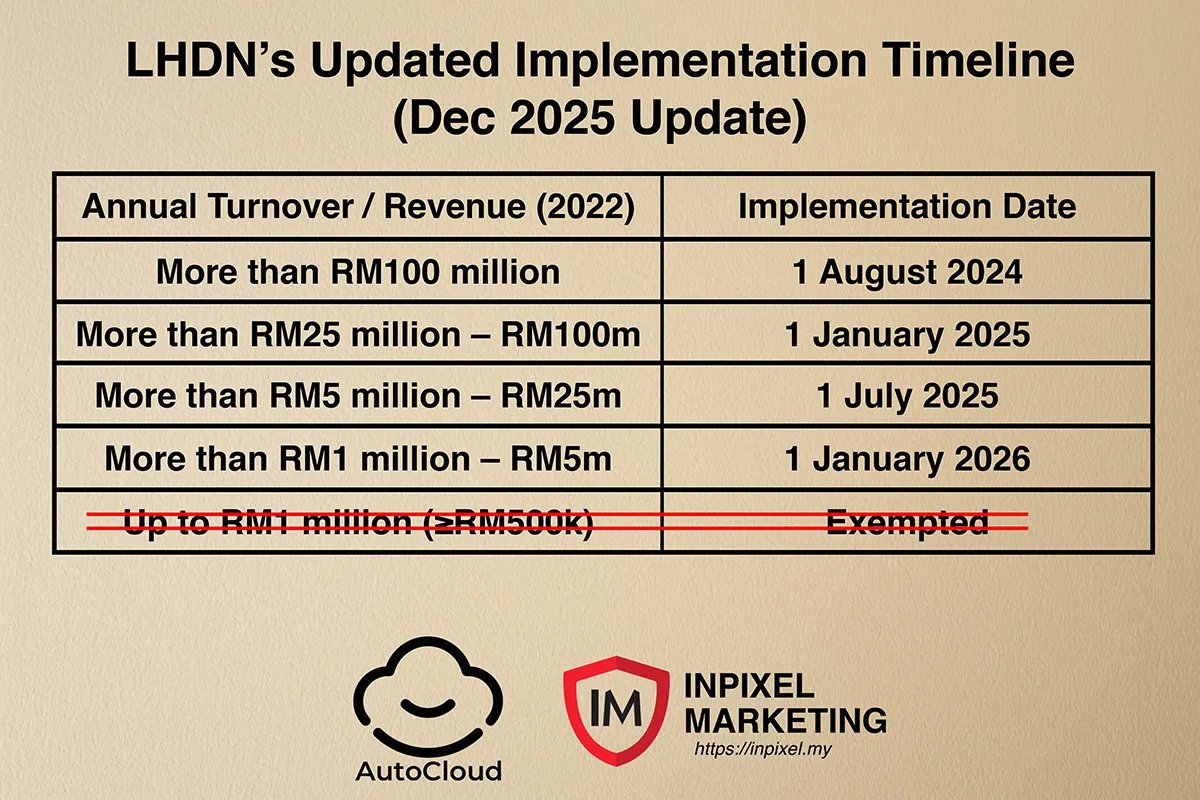
From 1 July 2025, the Sales and Service Tax (SST) framework in Malaysia will undergo a significant expansion in both scope and rate. For businesses, this means new categories of goods and services now become taxable, there are changed registration thresholds, transitional rules and compliance obligations. The upshot: companies must reassess their pricing, contracts, accounting and IT systems to ensure smooth adaptation. Moreover, cloud accounting tools such as AutoCount Cloud Accounting can play a vital role in helping businesses streamline the compliance and reporting burden.
In this blog post, we’ll unpack the changes, illustrate business impacts, and outline practical response methods with a focus on how AutoCount Cloud Accounting can assist.
What’s Changing: SST Expansion – The Latest Context
Here are key updates for the SST expansion:
1. Expanded scope of goods and services
- The government will apply sales tax at 5% and 10% on more goods (especially non-essentials and luxury items) starting 1 July 2025.
- Service tax categories are widened to include leasing/rental of goods & premises, construction services, financial services (fees/commissions), private healthcare (for non-Malaysians), private education (for non-Malaysians/students above threshold) and wellness/beauty services.
- For example, rental/leasing services of tangible assets used for business are now taxed at 8% beyond a given threshold.
2. New thresholds & transitional provisions
- Some service tax registration thresholds have changed (e.g., construction services threshold at RM1.5 million).
- Transitional rules apply for services spanning the date; for goods, invoices issued before 1 July may use old rate; new tax for goods released/imported from customs on/after 1 July.
- The government announced a grace period: companies that take steps to register and comply by 31 Dec 2025 will not face penalties/prosecution.
3. Why this matters
- The expansion is part of the Ministry of Finance Malaysia’s drive to strengthen the tax base and fiscal position.
- Businesses such as construction have warned that fixed-price contracts may be destabilised by added tax layers.
Impacts on Businesses – What You Need to Know
From a business-strategic and operational perspective, here are the major impact areas and risks.
A. Pricing & Cost Structure
- If your business sells goods that now fall under the 5% or 10% sales tax, you may need to adjust end-pricing or absorb cost.
- Service providers newly captured (leasing, construction, finance etc) will have a service tax of 6% or 8% depending on category — this increases cost or reduces margin.
- Supply chain cascading: if your suppliers are now taxed, their cost may increase, affecting your upstream costs. Risk of “tax-on-tax” should be managed.
B. Contractual & Invoice Handling
- Existing contracts (especially fixed-price) may not have accounted for the new SST burden. You may face margin erosion or need to negotiate changes.
- Invoices issued across the implementation date need to apply correct tax: e.g., for services spanning 1 July, only portion rendered after is taxable.
- Registration status: if you cross threshold for a new service category, you must register for service tax and issue tax invoices/returns accordingly.
C. Systems, Accounting & Reporting
- Your billing/invoicing system must be updated to include the new SST categories, correct rates (5%, 10%, 6%, 8%) and correct thresholds.
- Accounting software must tag goods & services correctly for SST, maintain documentation for audit, and support new tax code definitions.
- The compliance burden (registration, filing returns, keeping records) increases; manual processes raise risk of error.
D. Strategic/Operational Risk
- For industries like construction which flagged risk of project instability — where contracts signed before may escape tax but later ones will be taxed — cash flows and project budgeting may be affected.
- For SMEs with limited capacity for system change, the burden may divert resources from core business.
- Failure to comply (e.g., late registration, incorrect tax treatment) post-2025 may lead to penalties.
Practical Response Methods – A Road-Map for Businesses
Here is a structured action plan your business (or your clients, if you are advising) should follow.
Step 1: Tax scope & exposure assessment
- Review your product and service catalogue: identify which goods/services fall into the newly taxable categories (e.g., leasing/rental, finance fees, construction, private education/non-Malaysian, etc) using the official gazettes.
- Estimate the contribution of these goods/services to revenue and margin. Determine volume of affected transactions.
- Check whether your business crosses the registration thresholds for service tax under the new scope.
Step 2: Pricing & contract review
- For affected goods/services: assess whether you should absorb cost, pass it to customers, or redesign offering (bundle differently).
- Review contracts signed before 1 July 2025: check for non-reviewable clause exemption eligibility.
- For fixed-price contracts spanning the tax change, calculate the SST impact and consider amendment or contingency clauses for future agreements.
Step 3: System & accounting readiness
- Update your invoicing, billing and ERP systems to reflect correct tax code definitions, rates and effective dates.
- Ensure your accounting software supports the SST expansion: goods tagging, service categories, reporting, audit trail.
- Train your team (billing, sales, procurement, finance) on new tax rules, thresholds, transitional provisions.
Step 4: Registration & compliance
- If you need to register for sales or service tax under the new rules, do so promptly. Take advantage of the grace period (until 31 Dec 2025) to avoid penalties.
- Set up SST return processes: periodic returns, documentation, audit trails, invoices with correct tax treatment.
- Engage your tax advisor/accountant to monitor updates (gazette orders, guidelines) and ensure continual compliance.
Step 5: Leverage tools and automation
- To minimise manual error and resource drain, adopt accounting/cloud tools that are SST-ready and support automation of tagging, reporting, notifications.
- Use dashboards/analytics to monitor SST-impacted revenues/costs, margin erosion, pricing effectiveness.
- Build scenario modelling: “What if we change pricing by X%?”, “What if supplier costs increase by Y% because of SST?”, etc.
How AutoCount Cloud Accounting Helps
Given the complexity introduced by SST expansion, cloud accounting software becomes a strategic asset. Here’s how AutoCount Cloud Accounting supports businesses in this new tax environment:
- SST Compliance Built-In: The platform supports SST accounting treatment, allowing goods/services categorisation, tax code set-up and reporting aligned to Malaysian SST rules.
- Anywhere, Anytime Access: Being cloud-based means your accounting, invoicing, and SST-related data is accessible remotely, enabling multi-location collaboration and faster decision-making.
- Automated Billing & Document Management: You can issue invoices, quotations, credit notes etc while tagging the correct SST code, and submit e-Invoices (for Malaysian tax compliance) in one integrated flow.
- Real-time Dashboards & Reporting: Get immediate visibility on sales, costs, margins, and – crucially – SST-exposed categories. That means quicker strategic responses (pricing, contract renegotiation).
- Reduced Manual/Administrative Overhead: With bank feeds, data capture (OCR), and automated workflows, you reduce the risk of errors in SST categorisation, which is especially valuable when many new categories and thresholds are introduced.
- Scalable & Cost-Efficient: For SMEs especially, the cloud model enables lower initial cost, no heavy server investment, and easier upgrades — helpful when tax changes impose extra compliance cost.
Realism Check & Key Considerations
- Implementation Resource Needs: Selectively changing pricing, re-negotiating contracts, and upgrading systems take time and cost; plan early. SMEs may be resource-constrained.
- Taxpayer Education & Mistakes Likely: With many new categories and thresholds, there is a risk of mis-classification. Penalties may be relieved until 31 Dec 2025, but errors still must be corrected.
- Cascading Cost Risk: Even if you don’t fall under newly taxable categories, your suppliers might — this could increase their costs and indirectly raise your expenses. Don’t ignore supplier impact.
- Customer Response: Passing on tax costs may impact competitiveness or demand. If classification is ambiguous, customers may push back.
- Software Adoption Doesn’t Solve All: Tools like AutoCount Cloud Accounting help significantly, but you still need correct policy, classification decisions, and process discipline. Software is enabler, not complete solution.
Conclusion
The July 2025 expansion of Malaysia’s SST regime marks a turning point for many businesses. Without proper preparation, companies may face margin squeeze, contract risks, and compliance challenges.
However, with the right tools and strategy, this can become a chance to modernize your accounting system and future-proof your operations.
By adopting AutoCount Cloud Accounting, you gain:
✅ Built-in SST compliance and tax reporting
✅ Seamless e-Invoice integration
✅ Real-time financial dashboards
✅ Multi-branch access and automation
👉 Take control of your SST compliance today.
Learn more about how AutoCount Cloud Accounting can simplify your transition to the new tax framework:
🔗 https://autocloud.my/autocount-cloud-accounting/