Malaysia e-Invoice 2026: Who Must Comply After the RM3 Million Exemption
Since 1 September 2026, businesses with annual turnover or revenue below RM3 million are exempt from e-invoicing (HASiL media statement and Guideline v4.8, 30 August 2026), unless a group-company test applies. Businesses at RM3 million or more stay in e-invoicing from the start date LHDN sets. Those in the interim relaxation may consolidate all transactions until 31 December 2027.
Who must issue e-invoices in Malaysia now?
Malaysian businesses with annual turnover or revenue of RM3 million or more must issue e-invoices, from a start date set by LHDN’s phase table or, for businesses that reached RM3 million later, by the year they reached it. LHDN’s table has four phases plus a concessionary date of 1 July 2026. Smaller businesses are exempt unless a group-company test applies.
The table follows the LHDN e-Invoice implementation timeline (updated 30 Aug 2026), which matches Table 1.1 of Guideline v4.8. The bands are based on audited turnover for financial year 2022, or the turnover declared in the YA2022 tax return. There is no separate band starting on 1 January 2027.
| Annual turnover or revenue | Implementation date | Notes |
|---|---|---|
| More than RM100 million | 1 August 2024 | Phase 1 |
| More than RM25 million and up to RM100 million | 1 January 2025 | Phase 2 |
| More than RM5 million and up to RM25 million | 1 July 2025 | Phase 3; the relaxation for this group ended on 31 December 2025 |
| Up to RM5 million | 1 January 2026 | Phase 4; businesses below RM3 million are exempt; interim relaxation until 31 December 2027 |
| Below RM3 million in 2022 but reached RM3 million in YA2023, YA2024 or YA2025; or exemption lost under a group-company test | 1 July 2026 | LHDN calls this the concessionary implementation date; businesses up to RM5 million in this group are in the interim relaxation |
The 1 July 2026 date comes from the LHDN e-Invoice FAQ (updated 4 Sep 2026). Section 1.5 of Guideline v4.8 also applies it to new businesses that started between 2023 and 2025 with turnover of at least RM3 million. The end of the relaxation above RM5 million is noted in the LHDN e-Invoice Specific Guideline v4.9 (7 Sep 2026).
Limits: what this e-invoice guide is not
This guide explains LHDN’s published rules as of 9 October 2026. It is not advice on your own position, and Budget 2027 changes are not yet reflected.
- Not tax advice. Several rules depend on your group structure and on the year your turnover crossed RM3 million. Confirm your own position with your tax adviser before you stop or start issuing e-invoices.
- Dated facts. Everything here was checked on 9 October 2026 against LHDN’s e-Invoice Guideline v4.8 (30 August 2026), Specific Guideline v4.9 (7 September 2026) and FAQ (4 September 2026), and the other documents listed under Sources. Budget 2027 was tabled on 9 October 2026; its e-invoice measures, if any, are not yet reflected here. We will update this page if Budget 2027 or a new guideline changes the rules.
- LHDN documents only. Every rule is cited to an LHDN or HASiL document; Malay statements are summarised in English.
- Who we are. AutoCloud.my is operated by Inpixel Marketing (SSM 202003100521), an authorised AutoCount cloud reseller. We scope connections between AutoCount, MyInvois and other systems. Your accountant or tax adviser decides tax treatment.
Does the RM3 million exemption apply to my company?
The RM3 million exemption applies to a business whose annual turnover or revenue is less than RM3 million, unless a group-company test removes it. The exemption is lost if a non-individual shareholder (such as a company), holding company, related company or joint venture has turnover of at least RM3 million. Sole proprietors add up all their sole-proprietorship businesses.
The exemption sits in section 1.6.1(e) of the LHDN e-Invoice Guideline v4.8 (30 Aug 2026) and covers self-billed e-invoices as well. The group-company tests are in section 1.6.10, added in the same version (LHDN e-Invoice Guideline v4.8 (30 Aug 2026)). For sole proprietors, the LHDN e-Invoice FAQ (updated 4 Sep 2026) (Q102) counts every sole-proprietorship business registered under the owner’s name.
Check it in four steps
- Your own turnover. Is your annual turnover or revenue below RM3 million? If not, the exemption does not apply.
- Your shareholders. Does a non-individual shareholder have turnover of at least RM3 million? If yes, it does not apply.
- Your group. Are you a subsidiary of a holding company, or do you have a related company or joint venture, with turnover of at least RM3 million? If yes, it does not apply.
- Sole proprietors. Do all sole-proprietorship businesses under your name together reach RM3 million? If yes, it does not apply.
If every answer keeps you below the line, you are exempt under the current guideline; confirm it with your tax adviser before you stop issuing e-invoices.
The tests and where LHDN states them
| Test | The exemption is lost if | Where LHDN says it |
|---|---|---|
| Own turnover | Annual turnover or revenue is RM3 million or more | Guideline v4.8, 1.6.1(e) |
| Non-individual shareholder | A non-individual (corporate or equivalent) shareholder has annual turnover or revenue of at least RM3 million | Guideline v4.8, 1.6.10(a) |
| Holding company | The business is a subsidiary of a holding company with annual turnover or revenue of at least RM3 million | Guideline v4.8, 1.6.10(b) |
| Related company or joint venture | A related company or joint venture has annual turnover or revenue of at least RM3 million | Guideline v4.8, 1.6.10(c) |
| Sole proprietor | All sole-proprietorship businesses under the owner’s name together reach RM3 million | FAQ, Q102 |
“Related company” has the meaning in section 2 of the Promotion of Investments Act 1986. LHDN’s FAQ (Q103) explains that a company holding at least 20% of another’s issued share capital, or controlling its operations even below 20%, makes the two related. Two companies owned by the same individual shareholder are not related, and a common director with no shareholding does not make companies related. An exempt business does not need to apply to LHDN and may stop issuing e-invoices immediately, according to the LHDN e-Invoice FAQ (updated 4 Sep 2026) (Q17 to Q20).
How did the e-invoice exemption threshold change from RM150,000 to RM3 million?
The e-invoice exemption threshold has been set at four levels since October 2024: RM150,000 in Guideline v4.0 (4 October 2024), RM500,000 announced on 5 June 2025, RM1 million in Guideline v4.6 (7 December 2025), and RM3 million from 1 September 2026 under Guideline v4.8 (30 August 2026). Each step widened the exemption.
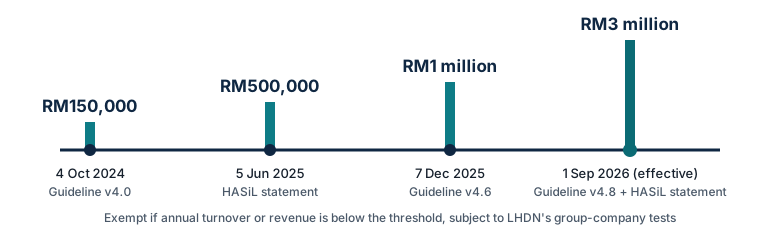
| Date (published, or effective for RM3 million) | Exempt if turnover is below | Source | Other changes at the same time |
|---|---|---|---|
| 4 October 2024 | RM150,000 | LHDN e-Invoice Guideline v4.0 (4 Oct 2024, archived copy) | The earliest version we checked; v4.0 replaced v3.2 of 30 July 2024 |
| 5 June 2025 | RM500,000 | HASiL media statement (5 Jun 2025) | The phase above RM1 million up to RM5 million moved to 1 January 2026, the phase up to RM1 million moved to 1 July 2026, and consolidation of any sale above RM10,000 was barred from 1 January 2026 |
| 7 December 2025 | RM1 million | LHDN e-Invoice Guideline v4.6 (7 Dec 2025) | v4.6 replaced v4.5 of 7 July 2025 |
| 1 September 2026 | RM3 million | HASiL media statement (30 Aug 2026) | Guideline v4.8 (30 August 2026) amended 1.5 and 1.6.1(e) and added 1.6.9 and 1.6.10 |
The 1 September 2026 effective date comes from HASiL’s media statement of 30 August 2026, which says the Government agreed to raise the threshold from RM1 million to RM3 million. Guideline v4.8 itself does not print an effective date for the new threshold. The same statement says more than 1.1 million traders benefit from the exemption.
Older articles may still show a separate phase for businesses up to RM1 million. That phase belongs to the June 2025 schedule and is not in LHDN’s current four-phase timeline.
What is the e-invoice interim relaxation period until 31 December 2027?
The interim relaxation period lets businesses with turnover up to RM5 million, whose e-invoice start date was 1 January 2026 or 1 July 2026, issue consolidated e-invoices for all transactions until 31 December 2027. LHDN’s Specific Guideline v4.9 also allows any product description and lets these businesses decline buyers’ requests for individual e-invoices.
The rules are in section 16 of the LHDN e-Invoice Specific Guideline v4.9 (7 Sep 2026). LHDN’s FAQ (Q115) says the relaxation is optional, and (Q116) that consolidated e-invoices are still due monthly. A consolidated e-invoice must reach LHDN within seven calendar days after the month ends (LHDN e-Invoice Specific Guideline v4.9 (7 Sep 2026)).
| Section | Allowed during the relaxation | Normal rule it relaxes |
|---|---|---|
| 16.2(a) | Consolidated e-invoices for all activities and transactions | Activities listed in section 3.7 normally need an e-invoice for each transaction |
| 16.2(b) | Consolidated self-billed e-invoices for all section 8.3 cases | Consolidated self-billed e-invoices only where the guideline normally allows them |
| 16.2(c) | Any information in “Description of Product or Service” | The description rules that normally apply |
| 16.2(d) | No individual e-invoice needed, even if the buyer asks for one | A buyer who asks receives an individual e-invoice |
LHDN’s Specific Guideline v4.9 relaxes the RM10,000 rule for this group too. Section 16.2(a) covers all activities listed under section 3.7, and the rule that any single transaction above RM10,000 needs its own e-invoice is one of them (LHDN e-Invoice Specific Guideline v4.9 (7 Sep 2026)). Confirm with your tax adviser before relying on it. During the relaxation, LHDN will not prosecute under section 120 of the Income Tax Act 1967 for e-invoice non-compliance, provided the business meets 16.2(a) and (b) (LHDN e-Invoice Specific Guideline v4.9 (7 Sep 2026)).
What is the e-Invoice Special Voluntary Disclosure Programme (SVDP)?
The e-Invoice Special Voluntary Disclosure Programme (SVDP) runs from 7 July 2026 to 31 December 2027. Businesses that missed e-invoices since their mandatory date, submitted e-invoices with errors, or submitted none can disclose them. LHDN says disclosed e-invoices face no compliance review, penalty or prosecution, except non-compliant disclosures or cases of fraud, wilful default or negligence.
The SVDP is set out in section 17 of the LHDN e-Invoice Specific Guideline v4.9 (7 Sep 2026). The points that matter in practice:
- Who can use it. Businesses that missed e-invoices since their mandatory date, submitted e-invoices with errors or non-compliant information, submitted none at all, or are under or notified of an e-invoice compliance review.
- How to submit. Disclosed e-invoices use e-invoice version “SVDP 1.2” (no digital signature) or “SVDP 1.3” (with a signature). Consolidated e-invoices are disclosed per month, not as one lump sum.
- No application. LHDN’s FAQ (Q127) says no registration or application is needed, and (Q132) each company in a group discloses separately.
- Not covered. Non-compliant SVDP e-invoices, and cases involving fraud, wilful default or negligence.
The HASiL media statement that introduced the programme on 7 July 2026 also said the Government agreed to allow a full capital allowance claim within one year on ICT equipment and on software development or customisation costs incurred to implement e-invoicing (HASiL media statement on the e-Invoice SVDP (7 Jul 2026)). We have not checked its effective dates or gazette rules, so treat it as an announcement and ask your tax adviser.
What happens if my turnover crosses RM3 million later?
A business whose turnover reaches RM3 million from YA2026 onwards must start e-invoicing on 1 January of the second year after that year of assessment. In LHDN’s FAQ example, turnover passed RM3 million by 31 August 2026, so e-invoicing starts on 1 January 2028. Businesses that crossed in YA2023 to YA2025 started on 1 July 2026.
| Year of assessment in which turnover reached RM3 million | e-Invoice start date | Source |
|---|---|---|
| YA2023, YA2024 or YA2025 | 1 July 2026 (the concessionary date) | FAQ Q12 and Q13 |
| YA2026 or later | 1 January of the second year after that YA (reached in 2026: 1 January 2028) | FAQ Q100 |
The rule is in the LHDN e-Invoice FAQ (updated 4 Sep 2026); Guideline v4.8 section 1.5 applies it to new businesses from 2026 too. A new business from 2026 that fails a group-company test starts on 1 July 2026 or when it commences, whichever is later (LHDN e-Invoice FAQ (updated 4 Sep 2026), Q14(a)).
LHDN’s FAQ (Q104) adds that once a business’s mandatory implementation year has been determined, no exemption will be granted, and it must keep issuing e-invoices even if turnover later stays below RM3 million (LHDN e-Invoice FAQ (updated 4 Sep 2026)). Read this narrowly. The same FAQ (Q15 to Q20) says businesses below RM3 million whose earlier start dates of 1 January 2026 or 1 July 2026 were set under the old thresholds are exempt and may stop. If your turnover moves around RM3 million, confirm your position with your tax adviser.
What are the penalties for not issuing an e-invoice?
Failure to issue an e-invoice is an offence under Section 120(1)(d) of the Income Tax Act 1967. LHDN’s FAQ states a fine of RM200 to RM20,000, imprisonment of up to 6 months, or both, for each non-compliance. During the interim relaxation and for SVDP disclosures, LHDN has said it will not take these actions, subject to conditions.
The penalty wording comes from Q41 of the LHDN e-Invoice FAQ (updated 4 Sep 2026). The table sets the general rule beside the two programmes that limit enforcement today.
| Situation | What LHDN says | Condition |
|---|---|---|
| General rule | Fine of RM200 to RM20,000, imprisonment of up to 6 months, or both, for each non-compliance | Offence under Section 120(1)(d), Income Tax Act 1967 |
| Interim relaxation (up to RM5 million, until 31 December 2027) | No prosecution under Section 120 for e-invoice non-compliance | The business issues consolidated and consolidated self-billed e-invoices as section 16.2(a) and (b) allow |
| SVDP disclosure (7 July 2026 to 31 December 2027) | No compliance review, penalty or prosecution for disclosed e-invoices | Not for non-compliant disclosures, fraud, wilful default or negligence |
Both programmes end on 31 December 2027, so plan your setup around that date.
What are consolidated and self-billed e-invoices?
A consolidated e-invoice combines a month of sales to buyers who did not ask for an e-invoice into one e-invoice, submitted within seven calendar days after the month ends. A self-billed e-invoice is issued by the buyer instead of the supplier, in cases LHDN lists, such as payments to agents, purchases from foreign suppliers and dividends.
Consolidated e-invoices
In a consolidated e-invoice the buyer’s TIN is the general public TIN EI00000000010 and the buyer’s name is “General Public” (LHDN e-Invoice Specific Guideline v4.9 (7 Sep 2026)). Outside the relaxation, consolidation is not allowed for some activities (LHDN e-Invoice Specific Guideline v4.9 (7 Sep 2026)): sale of motor vehicles, flight tickets and private charters, construction contracts, betting and gaming pay-outs (casino and gaming-machine pay-outs are exempted until further notice), payments to agents, dealers and distributors, and, from 1 January 2026, any single transaction above RM10,000 (LHDN e-Invoice Specific Guideline v4.9 (7 Sep 2026)), electricity supply, and telecom postpaid and internet subscriptions and device sales. Luxury goods and jewellery are listed but on hold.
Self-billed e-invoices
The buyer issues a self-billed e-invoice for payments to agents, dealers and distributors; purchases from foreign suppliers; profit distributions such as dividends; e-commerce transactions; betting and gaming pay-outs; purchases from individuals not in business; certain interest payments; insurance pay-outs; and capital reduction, share buyback, redemption or liquidation payments (LHDN e-Invoice Specific Guideline v4.9 (7 Sep 2026)). How these flow from AutoCount is covered in AutoCount to MyInvois e-invoice automation.
Portal or API: how do I submit e-invoices to MyInvois?
LHDN offers two ways to submit e-invoices: the free MyInvois Portal and the MyInvois API. A business may use either or both, as long as no e-invoice is sent twice. We found no turnover or volume rule in Guideline v4.8, Specific Guideline v4.9 or the FAQ that forces a business onto the API.
The two routes are described in Q3 of the LHDN e-Invoice FAQ (updated 4 Sep 2026) and in Table 2.1 of Guideline v4.8. AutoCount’s own e-Invoice Platform (AIP) submits standard, consolidated and self-billed e-invoices from AutoCount software to MyInvois (AutoCount e-Invoice Solution page).
| Route | What LHDN or the vendor says | Points to check |
|---|---|---|
| MyInvois Portal | Provided free by LHDN; accessible to all taxpayers | Do not send the same e-invoice through the API as well |
| MyInvois API, direct | Requires upfront investment; the guideline calls it ideal for large taxpayers or substantial volume | Up to 100 e-invoices and 5 MB per submission, 300 KB per e-invoice (MyInvois SDK: Submit Documents API) |
| API through an intermediary | An intermediary logs in with its own credentials plus the taxpayer’s TIN in an “onbehalfof” header | The intermediary can do only what the taxpayer has granted (MyInvois SDK: Login as Intermediary System) |
| AutoCount e-Invoice Platform (AIP) | Submits standard, consolidated and self-billed e-invoices from AutoCount to MyInvois | Covers invoices created in AutoCount; ask whoever supplies your AutoCount licence about setup |
Whichever route you use, a validated e-invoice can be cancelled, or rejected at the buyer’s request, only within 72 hours. After that, changes need a credit, debit or refund note (LHDN e-Invoice Guideline v4.8 (30 Aug 2026)). If your invoices start outside AutoCount, for example in a POS or web shop, see AutoCount API integration and MyInvois e-invoice automation.
What should an AutoCount user do about e-invoicing this month?
An AutoCount user should first confirm the turnover band and the group-company tests with a tax adviser, then check how AutoCount’s e-Invoice Platform (AIP) is set up, collect buyer details, and review past submissions for the SVDP. If invoices start outside AutoCount, a bridge may be needed; we scope that on a free 15-minute call.
- Confirm your turnover band and the group tests. Include any non-individual shareholder, holding company, related company or joint venture, and, for sole proprietors, every business under your name. Agree the result with your tax adviser.
- If you are exempt, decide whether to stop. No application to LHDN is needed. Keep a dated note of your reasoning.
- If you must comply, check your AIP setup with whoever supplies your AutoCount licence. Confirm standard, consolidated and self-billed e-invoices are set up for the documents you issue.
- Collect buyer details. Buyers who ask for their own e-invoice need one issued to them; other sales can go into the monthly consolidated e-invoice, except the activities LHDN bars from consolidation (unless the interim relaxation applies to you).
- Diarise the monthly deadline. Consolidated e-invoices are due within seven calendar days after each month ends.
- Review past submissions for the SVDP. Look for missed months, wrong e-invoices and transactions that should have been self-billed.
- Book a free 15-minute scoping call if invoices start outside AutoCount. A POS, marketplace or custom system may need a bridge.
Change log
- : page published; checked against e-Invoice Guideline v4.8, Specific Guideline v4.9 and the FAQ of 4 September 2026.
Key terms
- e-invoice
- An invoice submitted to LHDN’s MyInvois system and validated there. A validated e-invoice can be cancelled or rejected only within 72 hours; later changes need a credit, debit or refund note.
- MyInvois
- LHDN’s e-invoice system. Businesses reach it through the free MyInvois Portal, through the MyInvois API, or both.
- TIN
- Tax Identification Number. In a consolidated e-invoice the buyer’s TIN is the general public TIN EI00000000010; LHDN publishes other general TINs, such as EI00000000030 for foreign suppliers in self-billed e-invoices.
- Consolidated e-invoice
- One e-invoice that combines a month of sales to buyers who did not ask for an e-invoice, submitted within seven calendar days after the month ends.
- Self-billed e-invoice
- An e-invoice issued by the buyer instead of the supplier, in cases LHDN lists, such as payments to agents, dealers and distributors, purchases from foreign suppliers and dividend distributions.
- Interim relaxation period
- The period until 31 December 2027 in which businesses with turnover up to RM5 million and a start date of 1 January 2026 or 1 July 2026 may issue consolidated e-invoices for all transactions.
- SVDP (e-Invoice Special Voluntary Disclosure Programme)
- LHDN’s programme from 7 July 2026 to 31 December 2027 for disclosing missed, wrong or unsubmitted e-invoices without compliance review, penalty or prosecution, subject to exclusions.
Questions about e-invoicing and AutoCount? Book a free 15-minute scoping call: tell us your AutoCount edition and where your invoices start. We reply Monday to Friday, 9:00 am to 6:00 pm Malaysia time. Tax questions belong with your tax adviser.
WhatsApp +60 14-831 4005 Email hello@autocloud.myRelated guides
- AutoCount to MyInvois e-invoice automation: when invoices start outside AutoCount.
- AutoCount API integration: connecting a POS, marketplace or custom system to AutoCount.
- MyInvois error guide: common MyInvois submission errors and their fixes.
Sources
- LHDN e-Invoice implementation timeline (updated 30 Aug 2026), Inland Revenue Board of Malaysia (LHDN). Retrieved 9 October 2026.
- LHDN e-Invoice FAQ (updated 4 Sep 2026), Inland Revenue Board of Malaysia (LHDN). Retrieved 9 October 2026.
- LHDN e-Invoice Specific Guideline v4.9 (7 Sep 2026), Inland Revenue Board of Malaysia (LHDN). Retrieved 9 October 2026.
- LHDN e-Invoice Guideline v4.8 (30 Aug 2026), Inland Revenue Board of Malaysia (LHDN). Retrieved 9 October 2026.
- LHDN e-Invoice Guideline v4.0 (4 Oct 2024, archived copy), Inland Revenue Board of Malaysia (LHDN). Retrieved 9 October 2026.
- HASiL media statement (5 Jun 2025), Inland Revenue Board of Malaysia (LHDN). Retrieved 9 October 2026.
- LHDN e-Invoice Guideline v4.6 (7 Dec 2025), Inland Revenue Board of Malaysia (LHDN). Retrieved 9 October 2026.
- HASiL media statement (30 Aug 2026), Inland Revenue Board of Malaysia (LHDN). Retrieved 9 October 2026.
- HASiL media statement on the e-Invoice SVDP (7 Jul 2026), Inland Revenue Board of Malaysia (LHDN). Retrieved 9 October 2026.
- AutoCount e-Invoice Solution page, Auto Count Sdn Bhd. Retrieved 9 October 2026.
- MyInvois SDK: Submit Documents API, Inland Revenue Board of Malaysia (LHDN). Retrieved 9 October 2026.
- MyInvois SDK: Login as Intermediary System, Inland Revenue Board of Malaysia (LHDN). Retrieved 9 October 2026.