Consolidated e-Invoice in Malaysia: How the Monthly Submission Works
A consolidated e-invoice rolls one month of receipts, for buyers who did not need their own e-invoice, into a single e-invoice submitted to LHDN within seven calendar days after month end. The buyer is “General Public” with TIN EI00000000010. Motor vehicle sales, construction contracts and single sales above RM10,000 normally need individual e-invoices. Checked 9 October 2026.
Consolidated e-invoice rules at a glance
Every rule below comes from LHDN’s e-Invoice Specific Guideline v4.9 (7 September 2026); the size limits are cited from the MyInvois SDK and repeated in section 3.6.4. We checked each source on 9 October 2026.
| Question | LHDN rule | Source |
|---|---|---|
| What the buyer gets | A normal receipt. The receipt is not an e-invoice and is not sent to LHDN. | LHDN e-Invoice Specific Guideline v4.9 (7 Sep 2026) |
| How often | Monthly, covering the receipts of the previous month | LHDN e-Invoice Specific Guideline v4.9 (7 Sep 2026) |
| Deadline | Within seven calendar days after the month ends | LHDN e-Invoice Specific Guideline v4.9 (7 Sep 2026) |
| Buyer fields | Name “General Public”, TIN EI00000000010, “NA” for ID, address, phone and SST number | LHDN e-Invoice Specific Guideline v4.9 (7 Sep 2026) |
| Line items | One line per receipt, one line per unbroken run of receipt numbers, or one consolidated e-invoice per branch | LHDN e-Invoice Specific Guideline v4.9 (7 Sep 2026) |
| Size per submission | Up to 100 e-invoices and 5 MB, with each e-invoice up to 300 KB; split receipts across several consolidated e-invoices if needed | MyInvois SDK: Submit Documents API |
| Who is notified | The supplier only. Buyers are not notified, and the validated consolidated e-invoice need not be shared with them. | LHDN e-Invoice Specific Guideline v4.9 (7 Sep 2026) |
| Late buyer request | Allowed within the month of the sale; after that the supplier may decline. Businesses in the interim relaxation may decline any request (section 16.2(d)) | LHDN e-Invoice Specific Guideline v4.9 (7 Sep 2026) |
Limits of this guide: not for you if
This guide summarises LHDN’s published consolidation rules as of 9 October 2026. It is not tax advice and it has these limits:
- Your turnover is below RM3 million. Such businesses are exempt from issuing e-invoices unless a group-company test applies (LHDN e-Invoice Guideline v4.8 (30 Aug 2026)), effective 1 September 2026 (HASiL media statement (30 Aug 2026)). Check the Malaysia e-invoice guide first.
- You need a ruling on one sale. Whether a sale may be consolidated, especially above RM10,000 or in a listed industry, is for your tax adviser to confirm.
- Rules change. Specific Guideline v4.9 replaced Specific Guideline v4.8 of 7 July 2026 (LHDN e-Invoice Specific Guideline v4.9 (7 Sep 2026)). Check LHDN’s latest version before you rely on a date.
Who issues a consolidated e-invoice?
A consolidated e-invoice is issued by a supplier that must e-invoice and sells to buyers who do not need an e-invoice of their own, such as walk-in retail or restaurant customers. Those buyers get a normal receipt as before. Once a month the supplier reports the receipts to LHDN in one consolidated e-invoice, as proof of income.
LHDN’s guideline treats the receipt itself as outside the e-invoice system: it is “not e-Invoice” and is not submitted for validation (LHDN e-Invoice Specific Guideline v4.9 (7 Sep 2026)). Businesses below RM3 million turnover are exempt from issuing e-invoices unless a group-company test applies, so an exempt business issues no consolidated e-invoice.
Businesses inside the interim relaxation period (turnover up to RM5 million with a 1 January 2026 or 1 July 2026 start date) may consolidate all transactions until 31 December 2027, including sales that normally need their own e-invoice (LHDN e-Invoice Specific Guideline v4.9 (7 Sep 2026)). Confirm with your tax adviser whether your business is in that group.
How do you issue a consolidated e-invoice each month?
LHDN sets out four steps for a consolidated e-invoice. The supplier asks buyers whether they need an e-invoice, issues ordinary receipts to those who do not, then within seven calendar days after month end gathers the month’s receipts into one consolidated e-invoice and submits it through the MyInvois Portal or API with the required fields.
- Ask the buyer. At checkout, confirm whether the buyer needs an e-invoice.
- Issue a receipt. If not, issue the usual receipt.
- Gather the month. Within seven calendar days after month end, pull every receipt issued in the previous month (LHDN e-Invoice Specific Guideline v4.9 (7 Sep 2026)).
- Submit. Complete the consolidated e-invoice fields and submit it like any other e-invoice (LHDN e-Invoice Specific Guideline v4.9 (7 Sep 2026)).
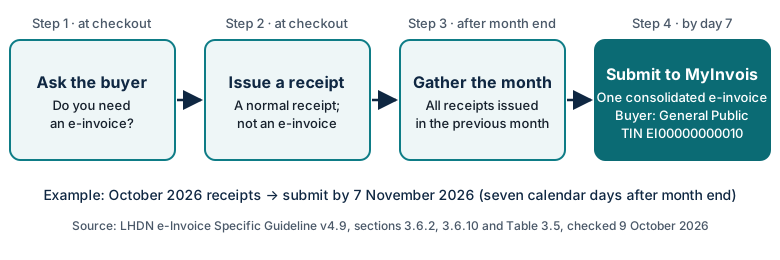
For October 2026 receipts, that means submitting by Saturday 7 November 2026. After validation LHDN notifies the supplier only, so no buyer can request a rejection. LHDN’s general rule still applies to the supplier: a validated e-invoice can be cancelled within 72 hours, and later corrections need a credit, debit or refund note (LHDN e-Invoice Guideline v4.8 (30 Aug 2026)).
What goes in the buyer fields of a consolidated e-invoice?
A consolidated e-invoice names the buyer as “General Public” and uses the general TIN EI00000000010, because no single buyer exists. The buyer’s identification or passport number, address, contact number and SST registration number are each entered as “NA”. Every other required field follows Appendices 1 and 2 of LHDN’s e-Invoice Guideline.
| Field | Enter |
|---|---|
| Buyer’s Name | General Public |
| Buyer’s TIN | EI00000000010 |
| Buyer’s Registration / Identification / Passport Number | NA |
| Buyer’s Address | NA |
| Buyer’s Contact Number | NA |
| Buyer’s SST Registration Number | NA |
The field values are in Table 3.5 of the LHDN e-Invoice Specific Guideline v4.9 (7 Sep 2026). EI00000000010 is one of several general TINs in Appendix 1 of the same guideline (LHDN e-Invoice Specific Guideline v4.9 (7 Sep 2026)); another, EI00000000030, is for foreign suppliers in self-billed e-invoices, so check the code your system sends.
How should receipts be listed in a consolidated e-invoice?
LHDN allows three ways to list receipts in a consolidated e-invoice, alone or combined: one line item per receipt, one line item per unbroken run of receipt numbers, or a separate consolidated e-invoice for each branch or location. Outside the interim relaxation, every receipt reference number must appear in the Description field.
Method 1: one line item per receipt
The summary of each receipt becomes its own line item, so the number of lines equals the number of receipts in the month. Each line carries that receipt’s reference number in the Description field.
Method 2: one line item per run of receipt numbers
A continuous run of receipt numbers is listed as one line item. Where the number chain breaks, the next run starts a new line item, so a month with no gaps can be a single line.
Method 3: one consolidated e-invoice per branch or location
Each branch or location submits its own consolidated e-invoice and lists its receipts using method 1 or method 2. The three methods may be used alone or combined.
The methods are in sections 3.6.3 and 3.6.11 of the LHDN e-Invoice Specific Guideline v4.9 (7 Sep 2026). A busy month can exceed the MyInvois limits of 100 e-invoices or 5 MB per submission and 300 KB per e-invoice (MyInvois SDK: Submit Documents API); the guideline lets suppliers split the receipts across several consolidated e-invoices to stay within them. Businesses in the interim relaxation are not restricted to receipt numbers and may enter any description (LHDN e-Invoice Specific Guideline v4.9 (7 Sep 2026)).
Which sales cannot go into a consolidated e-invoice?
Outside the interim relaxation, LHDN lists eight activities whose sales cannot go into a consolidated e-invoice and each need an individual e-invoice. They are motor vehicles, aviation, construction contracts, payments to agents and dealers, betting and gaming pay-outs, any single sale above RM10,000, electricity supply and telecommunications. The table below lists each one.
Activities that need an individual e-invoice
| Activity | What needs its own e-invoice | Applies from |
|---|---|---|
| Automotive | Sale of any motor vehicle | Already in force |
| Aviation | Flight tickets and private charters | Already in force |
| Construction | Construction contracts by construction contractors | Already in force |
| Agents, dealers and distributors | Payments to agents, dealers and distributors | Already in force |
| Licensed betting and gaming | Pay-outs to winners; casino and gaming-machine pay-outs are exempted from e-invoicing until further notice | Already in force |
| All industries | Any single transaction above RM10,000 | 1 January 2026 |
| Electricity | Electricity supplied by electricity service providers | 1 January 2026 |
| Telecommunications | Postpaid plans, internet subscriptions and electronic device sales | 1 January 2026 |
The list is Table 3.6 of the LHDN e-Invoice Specific Guideline v4.9 (7 Sep 2026). Table 3.6 also lists luxury goods and jewellery, but consolidation of those sales stays allowed until further notice.
The RM10,000 single-sale rule
The RM10,000 rule applies to all industries, counting each transaction on its own (LHDN e-Invoice Specific Guideline v4.9 (7 Sep 2026)).
Interim relaxation exception
LHDN’s Specific Guideline v4.9 relaxes the whole table for the interim relaxation cohort: section 16.2(a) allows consolidation of every activity listed in section 3.7, the RM10,000 row included (LHDN e-Invoice Specific Guideline v4.9 (7 Sep 2026)). Businesses above RM5 million turnover are outside that relaxation. Confirm with your tax adviser whether you are in that cohort before consolidating large sales.
What if a buyer asks for an e-invoice after getting a receipt?
A buyer who received a receipt may ask the supplier for an individual e-invoice within the month of the transaction. That cut-off lets the supplier leave the receipt out of the month’s consolidated e-invoice. LHDN’s own example shows a supplier declining a request made one day after the month ended.
The rule is section 3.6.8 of the LHDN e-Invoice Specific Guideline v4.9 (7 Sep 2026). In LHDN’s Example 5, a purchase on 30 September 2025 was followed by a request on 1 October 2025; the supplier, having already consolidated September, rejected it.
Businesses inside the interim relaxation have a wider option: section 16.2(d) lets them decline requests for individual e-invoices until 31 December 2027, provided they still issue the consolidated e-invoice (LHDN e-Invoice Specific Guideline v4.9 (7 Sep 2026)). Confirm with your tax adviser before you rely on it.
Can self-billed e-invoices be consolidated?
Self-billed e-invoices can be consolidated only in four LHDN cases: purchases from individuals not in business, interest paid to the public at large, insurance claim, compensation or benefit payments to individuals not in business or to government bodies, and self-billed cases involving a taxpayer’s overseas branches. A consolidated self-billed e-invoice is also due within seven calendar days after month end.
- Purchases from individuals not in business
- Interest paid to the public at large
- Insurance claim, compensation or benefit payments to individuals not in business or to government bodies
- Self-billed cases involving a taxpayer’s overseas branches or offices
The four cases are section 3.6.5 of the LHDN e-Invoice Specific Guideline v4.9 (7 Sep 2026). In a consolidated self-billed e-invoice the roles flip: the buyer issues it and enters “General Public” and EI00000000010 as the supplier. For businesses inside the interim relaxation, section 16.2(b) widens consolidated self-billing to every self-billed case in section 8.3 (LHDN e-Invoice Specific Guideline v4.9 (7 Sep 2026); the cases are listed in LHDN e-Invoice Specific Guideline v4.9 (7 Sep 2026)).
What if consolidated e-invoices were missed?
Missed consolidated e-invoices can be regularised through LHDN’s e-Invoice Special Voluntary Disclosure Programme (SVDP), which runs from 7 July 2026 to 31 December 2027. Each missed month needs its own consolidated e-invoice; LHDN does not accept one lump sum covering several months. Disclosed e-invoices face no compliance review, penalty or prosecution, with exclusions.
The one-per-month rule is section 17.6 of the LHDN e-Invoice Specific Guideline v4.9 (7 Sep 2026). In LHDN’s Example 23, a company that missed January to April 2026 submits four consolidated e-invoices. The SVDP protection does not cover non-compliant disclosures, fraud, wilful default or negligence, and disclosed e-invoices use the SVDP 1.2 or 1.3 e-invoice version (LHDN e-Invoice Specific Guideline v4.9 (7 Sep 2026)). Confirm your position with your tax adviser before disclosing.
Failing to issue an e-invoice is an offence under Section 120(1)(d) of the Income Tax Act 1967: a fine of RM200 to RM20,000, up to 6 months’ jail, or both, for each non-compliance (LHDN e-Invoice FAQ (updated 4 Sep 2026)). LHDN says it will not take penalty or prosecution action on e-invoices properly disclosed under the SVDP.
How do consolidated e-invoices work with AutoCount?
The AutoCount e-Invoice Platform (AIP) submits standard, consolidated and self-billed e-invoices from AutoCount software to MyInvois. If cash sales are already recorded in AutoCount, AIP is the first place to look. A separate bridge is usually needed only when receipts start in a non-AutoCount system, such as a third-party POS or online store.
AutoCount describes AIP on its e-invoice page (AutoCount e-Invoice Solution page). Where receipts live outside AutoCount, a bridge we scope is designed to bring each month’s receipt totals and reference numbers into AutoCount first, so the consolidated e-invoice can be prepared from the same records as your accounts. MyInvois e-invoice automation covers when that bridge is worth it.
Key terms
- Consolidated e-invoice
- One e-invoice, submitted to LHDN within seven calendar days after month end, that aggregates the month’s receipts for buyers who did not need their own e-invoice.
- General Public TIN
- EI00000000010, the general TIN LHDN lists for the buyer in a consolidated e-invoice and for the supplier in a consolidated self-billed e-invoice.
- Receipt reference number
- The number on each receipt. Outside the interim relaxation period, LHDN requires every receipt reference number in a month’s consolidated e-invoice to appear in its Description field.
- Interim relaxation period
- The period until 31 December 2027 in which businesses with turnover up to RM5 million and a 1 January 2026 or 1 July 2026 start date may consolidate all transactions.
Start with a free 15-minute scoping call. Tell us where your receipts start, how many outlets you run and how you file the monthly consolidated e-invoice today. If a project makes sense, we follow up with a written scope. We reply Monday to Friday, 9:00 am to 6:00 pm Malaysia time. AutoCloud.my is operated by Inpixel Marketing (SSM 202003100521), an authorised AutoCount cloud reseller.
WhatsApp +60 14-831 4005 Email hello@autocloud.myRelated guides
- Malaysia e-invoice 2026 guide: who must issue e-invoices after the RM3 million exemption.
- MyInvois error messages: causes and fixes for TIN, login and duplicate errors.
- AutoCount to MyInvois e-invoice automation: when invoices start outside AutoCount.
Sources
- LHDN e-Invoice Specific Guideline v4.9 (7 Sep 2026), Inland Revenue Board of Malaysia (LHDN). Retrieved 9 October 2026.
- MyInvois SDK: Submit Documents API, Inland Revenue Board of Malaysia (LHDN). Retrieved 9 October 2026.
- LHDN e-Invoice Guideline v4.8 (30 Aug 2026), Inland Revenue Board of Malaysia (LHDN). Retrieved 9 October 2026.
- HASiL media statement (30 Aug 2026), Inland Revenue Board of Malaysia (LHDN). Retrieved 9 October 2026.
- LHDN e-Invoice FAQ (updated 4 Sep 2026), Inland Revenue Board of Malaysia (LHDN). Retrieved 9 October 2026.
- AutoCount e-Invoice Solution page, Auto Count Sdn Bhd. Retrieved 9 October 2026.